Free Japanese Learning App, No Subscription Needed
Yes, you can learn Japanese with a free app and no subscription. Genuinely no-monthly-fee options include free apps supported by optional ads, one-time purchase apps that charge once and never again, and free web resources like grammar guides, kana lessons, and dictionaries that have always been free.
The catch is that “free” means different things across the app stores. Some apps are free forever, some are free to start but gate the useful parts behind a monthly fee, and some ask for a single payment instead. This guide sorts them out, gives you a quick comparison table, and shows you how to spot a hidden paywall before you download.
Free Japanese learning apps with no subscription, the short answer
If you just want names, here is the short version. For a free-forever path, lean on open web guides, free flashcard tools, and free dictionaries. For a polished app experience with no monthly fee, look at free apps with optional ads and at one-time purchase apps that charge once.
A few honest points up front. A truly free routine asks a little more setup from you, since you are stitching tools together. A one-time purchase can be cheaper over a year than a subscription, if you plan to study for the long run. And some excellent tools are free on Android and desktop yet cost a single fee on iPhone, which trips up a lot of readers.
There is no single right way to do this. Pick the mix that fits your budget, your phone, and the habit you can actually keep.
What no subscription really means: truly free versus freemium versus one-time purchase
The phrase “no subscription” hides four very different pricing models. Knowing which one you are looking at saves you from a surprise later.
- Truly free: the whole core experience is free, with no monthly fee. These are usually web guides, open flashcard tools, and dictionaries. Some are funded by donations or optional ads.
- Freemium: free to start and free to use at a basic level, sometimes with ads. A monthly fee removes ads or limits. The free tier can still be very usable on its own.
- One-time purchase: you pay once and own the app, with no recurring charge. This is the classic “no subscription” model that many readers actually want.
- Free trial then subscription: free for a few days, then it charges a monthly fee automatically. This one looks free in the store listing but is not free to keep.
When someone searches for a “Japanese app no monthly fee,” they usually mean the middle two: a free tier they can live in, or a single payment. The last model, free trial then subscription, is the one to watch for.
How we picked these apps
This is not a ranking of which app is “best,” because the best app is the one you will open every day. Instead, each option here is judged on a few practical points.
- Real pricing model: is it truly free, freemium, one-time purchase, or a trial that turns into a subscription?
- What you actually get for free: full lessons, or a teaser.
- Hidden costs: heart limits, locked review counts, daily caps, or ads.
- Platform fairness: whether the price is the same on Android, iPhone, and desktop.
- Beginner friendliness: clear kana, native audio, and smart reviews that schedule your practice for you.
Reading-recognition tools and handwriting tools are treated as complementary here. Both are valuable, and a good free routine usually uses a bit of each.
Quick comparison table: pricing model, what is free, hidden costs
Prices and exact limits change over time, so this table focuses on the pricing model and the shape of each option rather than a dollar figure. Always check the current price on your own device.
| Option | Pricing model | What is free | Hidden costs to watch |
|---|---|---|---|
| Open grammar guides (web) | Truly free | The entire guide, beginner to advanced | None, it is a website |
| Free kana lessons (web) | Truly free | All hiragana and katakana lessons | None |
| Free dictionary sites and apps | Truly free | Full word and kanji lookups | None for core lookups |
| Free flashcard tools (Android, desktop) | Truly free | Make and study unlimited decks | A one-time fee on iPhone for the same tool |
| Large free-tier learning apps | Freemium | A full beginner course, often with ads | Optional fee removes ads, or there may be heart or daily limits |
| One-time purchase study apps | One-time purchase | Varies by app, some let you try before buying | Pay once, then confirm what the single fee includes |
| Kana Conbini | Free to start, one-time pack | Both modes, full N5 to N1 vocabulary, native voice | Free tier limits daily handwriting with an energy meter, and a one-time pack makes it unlimited |
| Trial-then-paid apps | Free trial then subscription | A few days, then it charges monthly | Auto-renews into a subscription |
Use this table to set expectations, then verify the live price before installing.
The best free Japanese learning apps with no subscription
Here is how the genuinely no-monthly-fee options break down in practice. None of these requires a recurring payment to get real value.
For pure cost savings, free web resources are hard to beat. Open grammar guides such as Tae Kim’s Guide to Japanese Grammar walk you from your first sentence to advanced points, free to read in your browser. Free kana lesson sites teach both alphabets with audio. Free dictionaries like Jisho.org let you look up any word or kanji, including readings and example sentences. None of this costs a monthly fee, and it covers a surprising amount of a beginner’s needs.
For a flashcard habit, free spaced repetition tools let you build or download decks and review them daily. The smart scheduling brings each card back right before you would forget it, which is the engine behind most efficient study. Anki is the best-known example: the desktop version and the AnkiDroid Android app are free, while the AnkiMobile iPhone app asks for one payment. That split is the platform quirk to remember.
For a guided app feel, large freemium apps give you a full beginner course in the free tier, usually with ads. You can learn a lot without ever paying. The optional fee mainly removes ads or lifts a daily limit, so the free version stands on its own if you do not mind the occasional ad. If you are moving off a subscription app, our guides on Duolingo alternatives for kanji and the best kanji writing apps compare specific options.
Truly free forever: apps and resources that never ask for a monthly fee
These never put up a paywall, which makes them the backbone of a no-cost routine.
- Open grammar guides: full, structured lessons on a website, free to read forever.
- Free kana practice sites: hiragana and katakana with stroke order and audio.
- Free dictionaries: search any word or kanji, see readings, meanings, and examples.
- Free graded reading and listening: simplified news and beginner audio from public broadcasters.
- Free printable worksheets: practice writing by hand on paper, at zero cost.
If you want to start writing today, our free printable Japanese writing practice sheets give you a one-page hiragana and katakana sheet with stroke order, ready to print. Paper plus a free guide is a complete, no-fee starting kit.
One-time purchase apps worth it if you dislike subscriptions
If monthly fees are the dealbreaker, a one-time purchase is often the better math. You pay once and keep the app, which can cost less than a year of any subscription.
A few things make a single payment worth it:
- You plan to study for the long haul. Over a year or two, one payment usually beats recurring fees.
- You want no ads and no nagging. Many one-time apps are clean and quiet after you buy.
- You like owning your tools. No renewal date to track, no cancellation to remember.
When you compare one-time apps, check exactly what the single fee covers. Some give you the whole app for one payment, while others open just one feature. A few let you try the core experience for free first, which is the friendliest way to do it. There is no single right way here. If you dislike subscriptions, a one-time purchase is a perfectly good choice.
How to spot a hidden paywall before you download
A store listing can say “free” while the useful parts cost money. Run through this short checklist before you install. The ranking lists often skip it, and it saves real frustration.
- Heart or life limits: you get a few tries, then you must wait or pay to continue. A free tier should let you study a meaningful amount each day.
- Locked review counts: the app caps how many cards you can review for free, which quietly throttles your progress.
- Daily caps: a hard daily lesson limit that only a fee removes.
- Free trial that auto-renews: “free for 7 days” that charges a monthly fee on day eight unless you cancel. This is the most common surprise.
- “Free” that means demo: only the first unit is free and the rest is locked.
- Platform price gaps: free on Android or desktop, paid on iPhone. Check the price on your device, not a review written for another one.
A quick way to test any app: open it, find the pricing screen, and read what the free tier actually allows before you invest your time. If the free tier feels like a locked door, keep looking.
How to build a full free study routine without paying monthly
You do not need one perfect paid app. You can combine free tools into a complete routine. Here is a simple daily plan that costs nothing to start.
- Learn kana first. Spend your first week or two on hiragana, then katakana. There are 46 of each, and short daily sessions with a free app or stroke-order demo get you reading the building blocks fast.
- Build a small review habit. Add a free flashcard tool and study one small batch a day. Smart reviews schedule each word for you, so ten minutes is enough.
- Write by hand. Trace characters in correct stroke order on a free worksheet or in a handwriting app that checks your strokes on screen. Writing helps the shapes stick and makes look-alike kanji easier to tell apart.
- Read and listen to real Japanese. Use free graded news and native audio so words appear in context, not just on lists.
- Keep it steady. Five minutes on a busy day beats an hour once a week. Consistency is the part no app can buy for you.
Handwriting is the step people skip, and it is the one that locks characters into memory. Tracing in the correct stroke order, even a few times per character, pays off quickly.
For more free beginner guides and practice ideas, the learn hub gathers them in one place. You can mix and match whatever fits your week.
How Kana Conbini can help
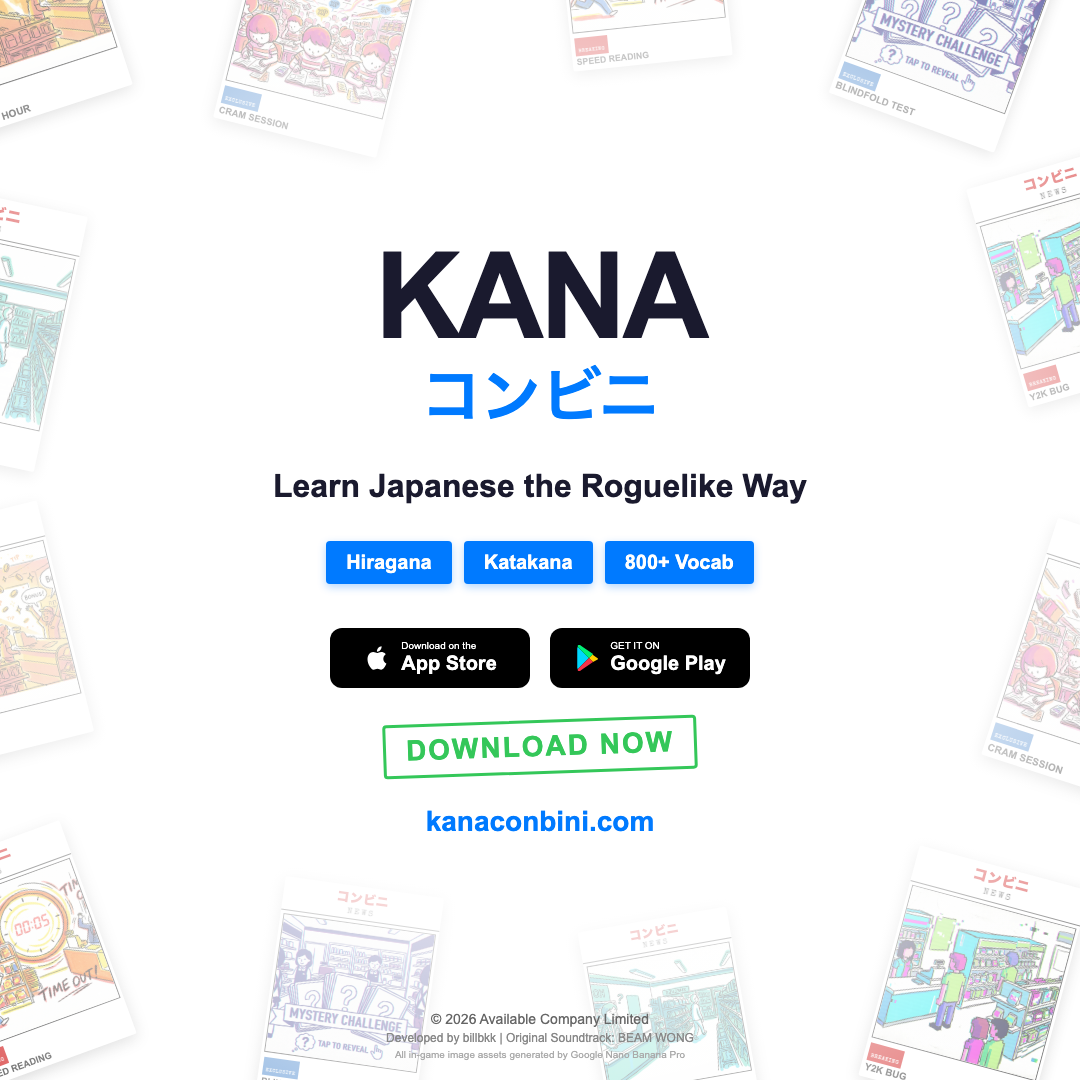
Kana Conbini is one friendly option among many, built for learners who want to read and write without a monthly fee. It is free to start on iPhone and Android, with no subscription.
- Free to start, no subscription. Both modes are there from day one, and a one-time pack is the only optional purchase.
- Two complementary modes. Conbini Run is a reading-recognition game where you serve customers by reading hiragana, katakana, and kanji. Write Kanji is a dedicated handwriting mode with stroke-order guides that fade as you improve.
- The full JLPT range, available now. More than 10,000 real vocabulary words from N5 to N1, each with native Japanese voice.
- Smart reviews and fading mnemonics. Each card comes back right before you would forget it, and the visual hints fade as you master the word.
- An honest free tier. In the free version, daily handwriting uses an energy meter that refills over time or with an ad, and a one-time pack makes it unlimited.
If you want a no-fee place to begin, the home page shows both modes in action. Try a few free tools, keep the ones you enjoy, and study in whatever way feels right for you.
FAQ
Is there a Japanese learning app with no subscription?
Yes. Several apps let you learn Japanese without any monthly fee, including free apps supported by optional ads and apps that ask for a single one-time purchase. Free web resources and flashcard tools also cover a full beginner path at no cost.
What is the most free Japanese learning app?
The most genuinely free options are open web guides and flashcard tools that never charge a monthly fee, such as free grammar guides, free kana lessons, and free dictionaries. Some apps are also free on Android and desktop while charging once on iOS.
Can I learn Japanese for free without a paywall?
Yes, you can reach a solid beginner level using only free tools. Combine a free kana app, a free grammar guide, free graded reading, and a free flashcard habit. The main limit on a free routine is your own consistency, not money.
Are there Japanese apps with no ads and no subscription?
Some one-time purchase apps remove both ads and subscriptions for a single payment. Free web resources like grammar guides and dictionaries also tend to be clean and ad-light, so you can study without interruptions.
What free apps can teach me hiragana and katakana?
Many free apps and free printable sheets cover all 46 hiragana and 46 katakana. Look for one that shows stroke order and lets you practice writing, since both sets are the foundation for everything else in Japanese.
Is a one-time purchase better than a subscription for learning Japanese?
It depends on how long you plan to study. A one-time purchase can cost less over a year or more, while a subscription may suit shorter bursts of study. There is no single right way, so choose what fits your budget and habits.
What is the best free Japanese app for beginners?
The best free app for you is the one you will open every day. Beginners usually want clear kana lessons, native audio, and smart reviews. Try two or three free options for a week and keep the one that feels easy to return to.
Is there a free kanji practice app?
Yes. Several free apps and worksheets let you practice kanji, including stroke-order tracing and recognition drills. Free flashcard tools also let you build or download kanji decks at no cost.
Are Japanese apps free on Android but paid on iOS?
Sometimes. A few well-known tools are free on Android and desktop but charge a one-time fee on iOS. Check the price on your own device before downloading so there are no surprises.
How can I practice Japanese writing for free?
Use a free printable practice sheet or a free app with on-screen stroke-order guides. Writing each character a few times by hand, in the correct stroke order, is one of the most effective free ways to remember it.